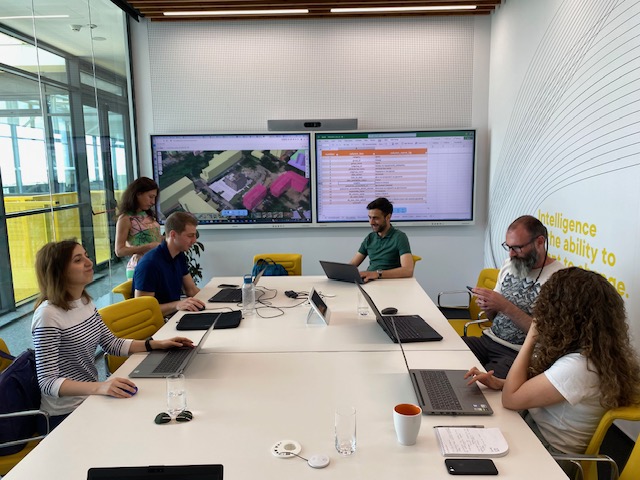
In the context of this problem, GATE Institute investigates urban heat islands in Sofia. The studies are based on the Weather Research and Forecasting (WRF) numerical model and available city data on electricity consumption, traffic, population, etc. Part of the research is the development of an energy atlas of Sofia, which will be presented for the first time at the international scientific conference Geospatial Week in September 2023 in Cairo, Egypt. The conference is under the auspices of the International Society for Photogrammetry and Remote Sensing – an organization developing international cooperation in the field of photogrammetry, remote sensing and their applications.
The Research Lead of the study is Dr. Lidia Vitanova, an environmental engineer and climatologist with research experience in the field of urban climate, heat islands, ecology and environmental protection. The results of the performed analyzes are integrated into the 3D model of the city, developed as a pilot for the “Lozenets” area. It is continuously enriched with data from a variety of sources and is the ground for the realization of various use cases related to urban processes and phenomena, including the impact of climate change. Cities like Helsinki, Vienna, Berlin, Singapore and New York have similar 3D models.
The research is carried out within the ‘City Digital Twin’ project, which performs analyzes and simulations related to air quality, parametric urban planning, energy efficiency, walkability, etc. Its development is under the supervision of Prof. Dr Desislava Petrova-Antonova, Research Lead at GATE Institute.